DeeKeep Deezer Music Converter Review 2026: Is It Safe?
 By Olivia Anderson
More Tips
Updated on 6/23/2026
By Olivia Anderson
More Tips
Updated on 6/23/2026
If you pay for Deezer Hi-Fi, you probably love that crisp, studio-grade Lossless FLAC audio. But let’s be real: we don't actually own our music on streaming platforms. We are just renting it. The moment an artist pulls an album due to copyright issues, or you decide to stop paying the monthly subscription, your favorite playlists simply vanish into a grayed-out void.
That's why tools like DeeKeep Deezer Music Converter exist. But if you are like me, you don't trust marketing hype. Before buying it, I checked Reddit and Trustpilot, and some reviews were enough to make anyone nervous. While DJs and audio collectors praise it, some users complain about sudden registration errors, while others worry if logging into an embedded browser is even safe, which is exactly why you are searching for a comprehensive DeeKeep review.
To find out the truth, I bought the 2026 version of DeeKeep with my own money and used it as my daily music archiver for a week. There is no corporate PR talk here, just my honest experience with the pros, cons, and the final verdict.
Part 1. What Exactly is DeeKeep?
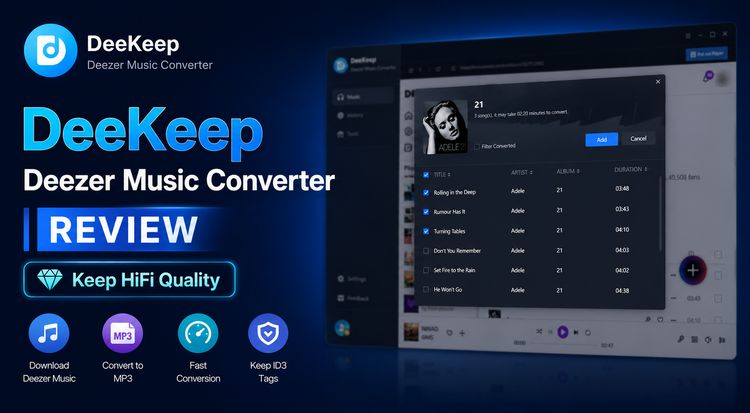
Simply put, DeeKeep is a desktop software for Windows and Mac that rips Deezer songs and saves them as regular files on your hard drive.
Unlike traditional recorders that require you to open the official Deezer app, DeeKeep has an embedded Deezer Web Player built right inside it. It looks and works just like a regular web browser. You log into your Deezer account inside the app, pick your songs, and it bypasses the platform's restrictions to copy the audio stream into standard formats like FLAC, MP3, etc.
Once it finishes, you get permanent files that you can put on a flash drive for your car, drop into an old MP3 player, or back up forever.
Part 2. Hands-On Performance: What Blew Me Away
To see if DeeKeep is actually worth your investment, I did not just run a quick two-minute test. I used it heavily as my primary music downloader for a whole week, pushing it with huge playlists and various output settings. After testing every corner of the software, here are the real-world results that stood out the most.
Feature 1: No Need to Install the Official Deezer App
My computer's memory breathed a huge sigh of relief. Because DeeKeep uses its own built-in web player, you don't need to download the clunky, heavy official Deezer desktop app. It is lightweight, fast, and does not lag your computer in the background.
Feature 2: Multi-Playlist Queueing and Fast Speed (The Ultimate Time-Saver)
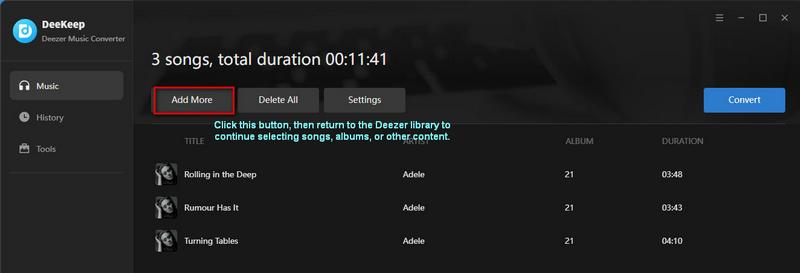
This feature is a game-changer for big music libraries. With standard tools, you usually have to wait for Playlist A to finish downloading completely before you can even browse for your next album. DeeKeep fixes this annoying bottleneck perfectly by letting you stash multiple playlists into a background waiting pool while you keep exploring the built-in player. You can build up a massive download session from different artists and then trigger one giant batch download with a single click.
The conversion speed is also impressive. My own computer setup and internet speed are completely average, but the real-world results still made me very satisfied. For example, a track that was just over 4 minutes long took only about 40 seconds to finish saving to my hard drive. It runs smoothly and efficiently even if you do not own a high-end, expensive PC.
Feature 3: True Hi-Fi Quality (The Spek Test)
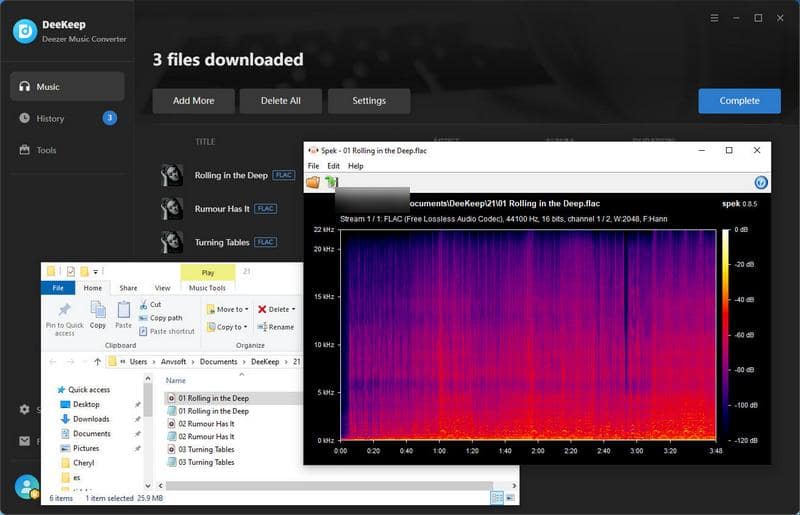
The biggest question for any music ripper is whether this is real lossless audio or just fake, upscaled garbage. To test it, I downloaded Adele's Rolling in the Deep as a FLAC file via DeeKeep and loaded it into a free audio analyzer called Spek.
The results were perfect. Standard compressed MP3s usually cut off flat at 16kHz or 20kHz to save file space. But as you can see in my test screenshot, the colorful audio data lines for this 16-bit 44.1 kHz track push naturally and smoothly all the way up past the 22kHz ceiling. There are no artificial flat lines or empty blank spaces at the top. This absolute visual proof confirms that DeeKeep is grabbing the genuine, untouched CD-quality stream directly from Deezer.
-
💡 Quick Tip: To ensure you get the original Hi-Fi quality from Deezer, keep the output format set to the default "Recommended" option instead of changing it manually. Also, if your internet connection tends to be unstable, switch the conversion mode to "Record mode". This prevents the software from accidentally dropping the connection and swapping the audio source to YouTube.
Feature 4: Organizing My Library with ID3 Tags and LRC Lyrics
Anyone who collects local music files knows the nightmare of a messy folder. There is nothing worse than downloading an album just to see a chaotic mix of missing covers, anonymous track numbers, and blank artist fields.
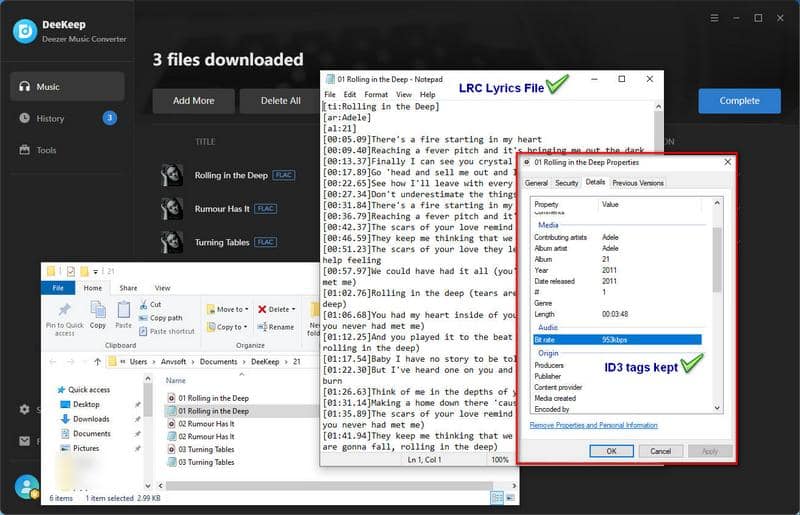
DeeKeep handles this sorting process pretty well. During my test, I went into the settings menu and selected "Album" for the output organization and chose "Track Number" + "Title" for the file naming rule. When the download finished, the software successfully created a clean folder named exactly after the album. Inside, every song was exported in its correct original sequence with the proper artist names and covers already attached.
Another feature worth pointing out is the text-based.LRC lyric files. If you tick the "Save lyric (if provided)" box before hitting download (You can see this on the Settings module by scrolling down.), it saves a separate lyric file alongside each song.
For casual listeners, this might not matter much. But if you rely on offline media players like AIMP or Foobar2000, these files are incredibly useful because they enable beautifully timed, synchronized scrolling lyrics right on your screen. Since the LRC is a universally accepted format, these lyrics will also display correctly on high-end portable music players or your car dashboard screen when playing music from a USB drive. It is a very practical addition if you like singing along or want a clean local archive.
Feature 5: Extra Little Features That Come in Handy
Even though you are probably only using this to grab music, the software has a few hidden features that come in pretty handy for sorting your files.
- Listen Right Away: You do not need to close the app to check your new songs. Just go to your history logs to play them right inside the software, whether you want to make sure the audio sounds right or just sit back and enjoy the track.
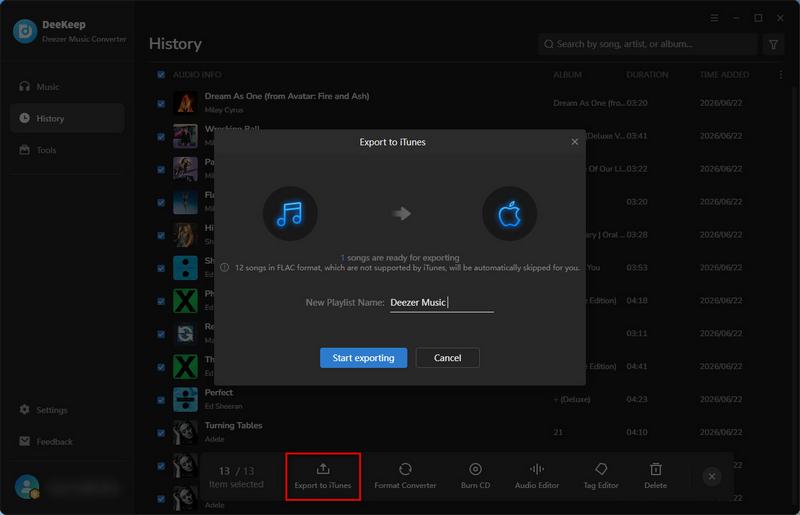
- Send to iTunes: If you use Apple devices, this saves you a lot of dragging and dropping. Once your music is done converting, just highlight the tracks in your history list and send them straight to your iTunes library with one click.
- A Mini Toolbox: There is a side menu with tools to change file formats, fix song details, or burn CDs. They are pretty basic, but they save you from downloading extra apps just to fix a file or make a quick CD for an older car.
-
⚠️ Please note: If you want to sync your converted Deezer songs to iTunes, you need to choose an output format that iTunes supports, such as ALAC, AIFF, WAV, AAC, or MP3. Since I converted my songs into the FLAC format, they were automatically detected and filtered out during the sync.
Part 3. How to Use DeeKeep to Download Hi-Fi Deezer Music?
I usually hate dealing with complicated software, but this one didn't give me any headaches. Setting everything up to get the best audio quality is a breeze. Let's look at the exact steps I took to get my tracks.
Step 1 Log In to Your Deezer Account and Find Your Songs
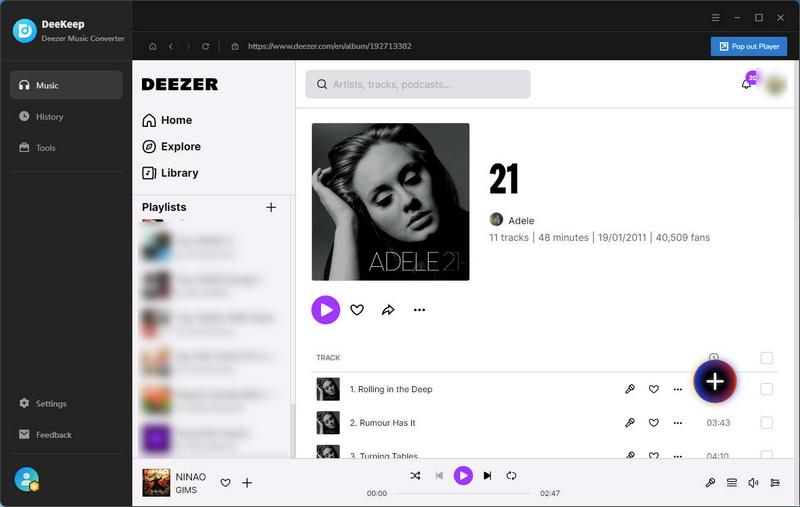
Launch the software, and the built-in Deezer web player will pop up automatically. Just log into your account to get started. Navigate to the songs you wish to download from your library, and click the "+" button to parse them.
Step 2 Choose Your Tracks for Conversion
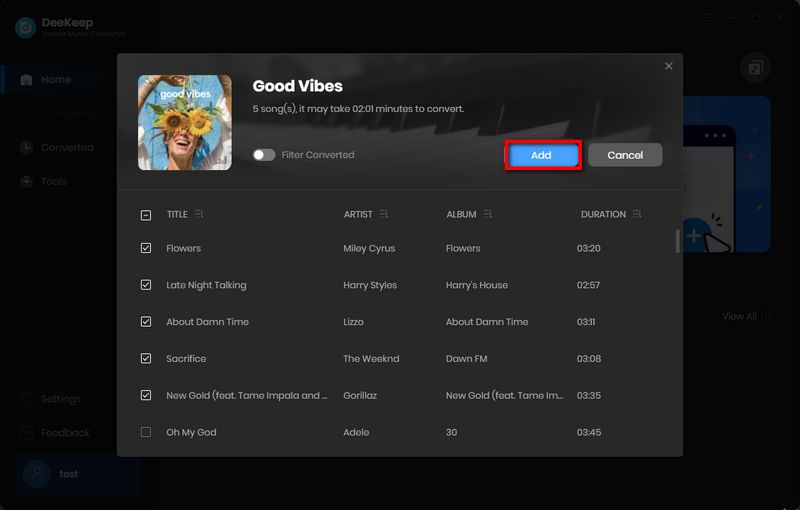
A window will pop up with your parsed music. Check the boxes next to the songs you want, and click on the "Add" option to put them into the download queue.
Step 3 Pick Your Settings and Start the Download
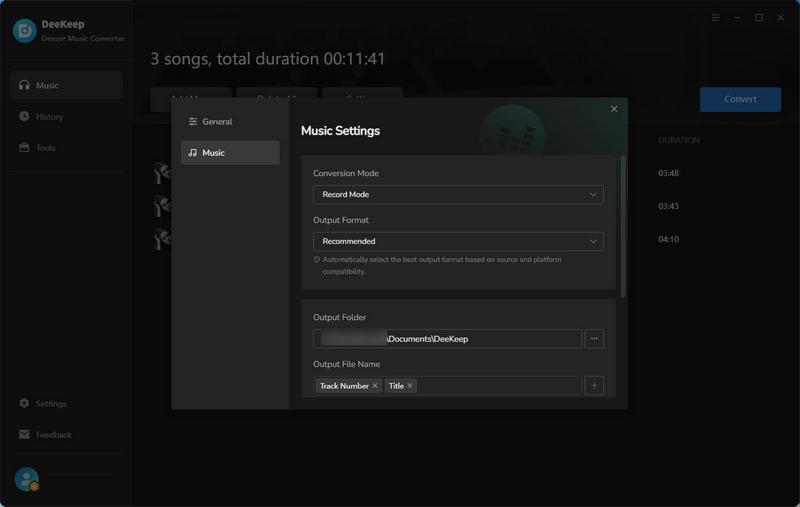
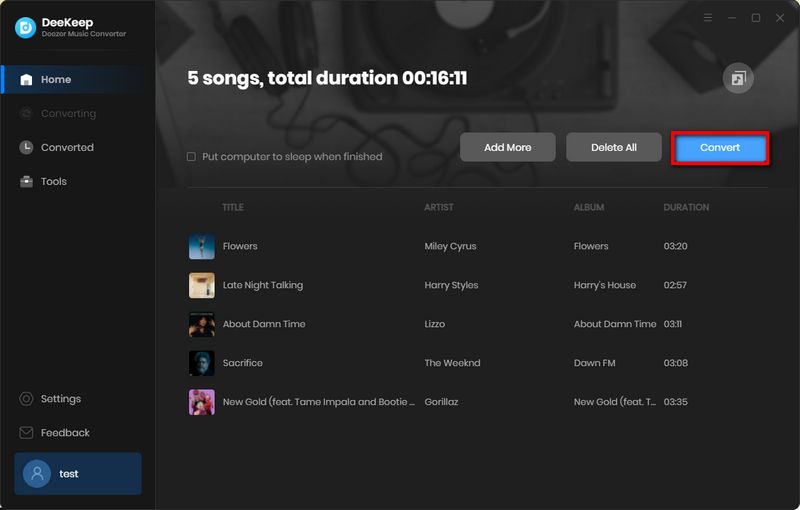
Before hitting the final button, head over to the "Settings" menu on the left side. Here, you can quickly choose your preferred output format (MP3, AAC, WAV, FLAC, AIFF, and ALAC), pick a saving folder, and organize your file names. Once that is set, just hit "Convert" to start the process.
-
💡 Keep in Mind: Leave the output format on "Recommended" to lock in Deezer's original Hi-Fi quality. If your Wi-Fi is unstable, switch the conversion mode to "Record mode" to prevent connection drops or accidental audio switching to YouTube.
Part 4. Fact or Fiction: Inspecting the Worst Online Reviews
Let’s talk about the negative reviews online. I investigated the most common complaints on Trustpilot and Reddit to see what is actually going on with this software.
❌ The License Issue: "The software suddenly says my license key is invalid!"
The Truth: I saw a few annoyed users on their Trustpilot feedback page saying the app forgot their lifetime account. This isn't a scam because it is usually caused by simple mistakes or system updates. According to the official FAQ, about 99% of registration failures happen because users accidentally add an extra space, mix up uppercase and lowercase letters, or type the wrong email address. Another common mistake is downloading the wrong version, since the license keys for Windows and Mac are not interchangeable.
In other rare cases, a major OS update or system reinstallation can wipe out the local cache, making the app forget the key. If this happens to you, just double-check your typing and re-enter your code to fix it instantly. Still, the development team should definitely look into optimizing this verification process to prevent these user errors. To avoid losing any money, there is no need to rush into buying a new license, and you can simply contact customer support to get it sorted out.
❌ The Security Doubt: "Is it safe to type my Deezer password into the built-in browser?"
The Truth: Tech-savvy users on music hoarding communities like Reddit's r/musichoarder often worry about account safety with third-party tools. However, DeeKeep uses a secure, sandboxed browser that loads the official, encrypted Deezer login page. The software only records the audio stream and does not steal your data. I checked my own account security logs during testing, and no weird logins were detected. So from a technical standpoint, your credentials are in safe hands.
❌ The Support Issue: "Customer support takes way too long to reply."
The Truth: This complaint is completely valid. Because the tech team operates in a different time zone, there is no instant live chat or phone support. If you send an email to [email protected], you will usually wait around 24 hours for a reply. On the bright side, they do reply to 100% of negative reviews online and consistently push out free updates whenever Deezer changes its website code.
Part 5. The Verdict: Is DeeKeep Worth Your Money in 2026?
Let's be honest, testing third-party software is usually a hit-or-miss experience. But after spending some real time with DeeKeep, it is clear that this tool is a lifesaver for people who still like to download and keep their Deezer music. Instead of paying monthly just to "rent" your favorite tracks from an app, this lets you pull the actual files onto your hard drive so they are yours for good.
What I Loved 👍
 Real Hi-Fi FLAC quality that downloads in just a few seconds without making you wait.
- No need to install the heavy official Deezer app.
- Multi-playlist queueing saves massive download time.
- Clean ID3 tags and .LRC scrolling lyrics that just work.
- Useful extra features like one-click syncing to iTunes, CD burning, and an easy tag editor.
What to Consider 👎
 Occasional downtime when Deezer updates its platform, though the team fixes it quickly with free updates.
- No instant live chat support with a 24-hour email turnaround.
- The registration process has room for improvement, as major system updates can glitch the license key and require you to re-enter it.
My Final Recommendation:
If you just listen to music on wireless earbuds during your commute, save your money. The official app's standard offline mode is perfectly fine for casual listening.
However, this tool is highly useful if you want real control over your music library. It is built for three types of people. First, it is for DJs who need a rock-solid backup of FLAC files on a USB drive when venue Wi-Fi drops. Second, it is for audiophiles who want uncompressed audio for high-end players or expensive headphones. Finally, it fits home server enthusiasts who are building a permanent collection on Plex or a NAS. With this tool, you do not have to worry about your favorite tracks vanishing overnight due to licensing issues.
DeeKeep ensures you actually keep the high-fidelity quality you pay for. If you fit into that second group, I highly recommend downloading the free trial. Test it out with your favorite album and let your own ears make the final decision.
Olivia Anderson
Senior Writer