Tidabie Tidal Music Converter Review 2026: The Pros, Cons & Verdict
 By Olivia Anderson
More Tips
Updated on 8/26/2026
By Olivia Anderson
More Tips
Updated on 8/26/2026
If you are like me, you are probably paying for a Tidal subscription just to get that beautiful, studio-grade HiRes FLAC audio, which is exactly why you are searching for a comprehensive Tidabie Tidal Music Converter review. Naturally, you want to back up your favorite playlists locally before they get removed or modified by the platform. But before I stumbled upon this tool, I was just as curious and highly skeptical as you are.
And trust me, when I googled reviews about this tool, the internet gave me serious anxiety. Over on Reddit, hard core audiophiles were screaming that Tidabie is totally misleading, claiming professional tools like Audirvana detect only compressed MP3 streams under a fake FLAC wrapper. Meanwhile, Trustpilot is flooded with complaints about CPU temperatures spiking, software failing after official Tidal updates, and slow customer support.
Audio cheating? Hardware hijacking? Absent service? To find out the truth, I bought the latest 2026 version of Tidabie with my own money and spent the last week running it on my PC. No PR corporate talk here, just my honest experience with the pros, cons, and the final verdict.
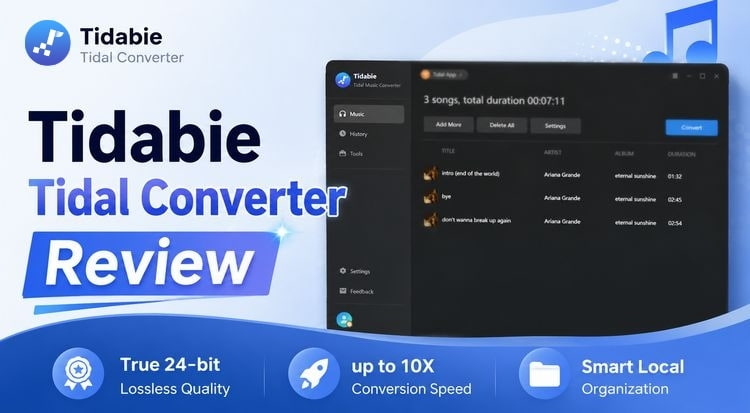
Part 1. What is Tidabie Tidal Music Converter? (2026 Overview)
To be completely honest, Tidabie Tidal Music Converter is just a software that lets you rip Tidal songs and save it as regular files on your computer.
If you already pay for Tidal, you know the drill. Their "offline mode" is a joke. You download a playlist, but you cannot actually touch the files. Tidal hides the music in an encrypted folder that only their own app can open. The moment you stop paying your monthly fee, or if an artist pulls their album because of some licensing fight, your music is gone. You are basically just renting the songs.
That is why people look for tools like Tidabie. It is a desktop converter for Windows and Mac. You log into your account through the tool, select your tracks, and it copies the audio stream into formats you can actually use, like FLAC or MP3.
Once it finishes, you get normal audio files on your hard drive. No blocks, no app requirements. You can put them on a cheap flash drive for your car, drop them into an old MP3 player, or keep them as a permanent backup. It simply forces Tidal to give you the actual files you are paying for anyway.
Part 2. My Real Testing Results: What I Actually Loved
To see if Tidabie is actually worth your money, I used it heavily as my daily driver. Here are my honest thoughts from my own test bench.
Feature 1: Dual Source Selection
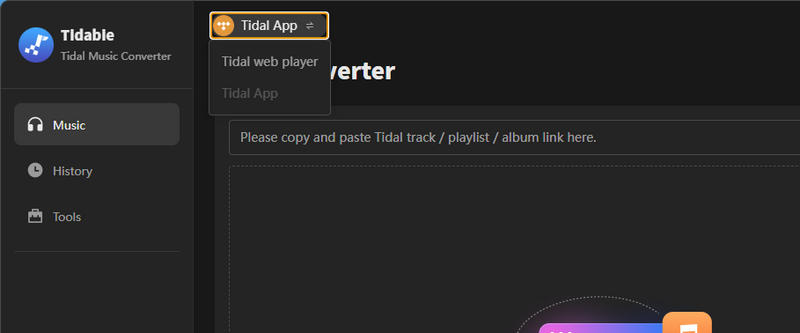
When you open the app, the interface is clean and modern. You will see a switch button in the top-left corner that lets you grab songs from either the Tidal Web Player or the Tidal App. I tested both, and they definitely do not work the same way.
The Web Player Option: If you do not want to install the official Tidal app on your computer, this is the easiest route. It is quick, highly convenient, and the conversion actually runs a bit faster.
The Tidal App Option: This mode gives you way more flexibility for importing music. Instead of just using the basic one-click "+" button, you can copy-paste track links or simply drag and drop songs directly into the window. To be honest, the one-click button is more than enough for me since it is the most direct path, but having options is great for different workflows.
Feature 2: 10X Speed is a Lifesaver for Big Playlists
Nobody likes sitting around waiting for downloads. Tidabie supports batch conversion, meaning you can grab songs from different playlists all at once, and it officially claims to support up to 10X speed.
Based on my actual testing, if you choose to convert songs from the Tidal web player, you can definitely hit that 10X speed. You just need decent computer specs and a fast internet connection. However, if you convert songs from the Tidal app, it runs a bit slower, topping out at around 4X-5X speed.
Since my own computer setup is pretty old and does not exactly run super smooth day to day, I tested it with a high quality Tidal track. To convert a roughly minute song into a Hi-Res FLAC file, it took me about 1 minute. Honestly, that felt perfectly acceptable. If you do not care that much about high res audio and choose standard formats instead, the whole process will take even less time.
Feature 3: The Audio Quality is Actually Massive
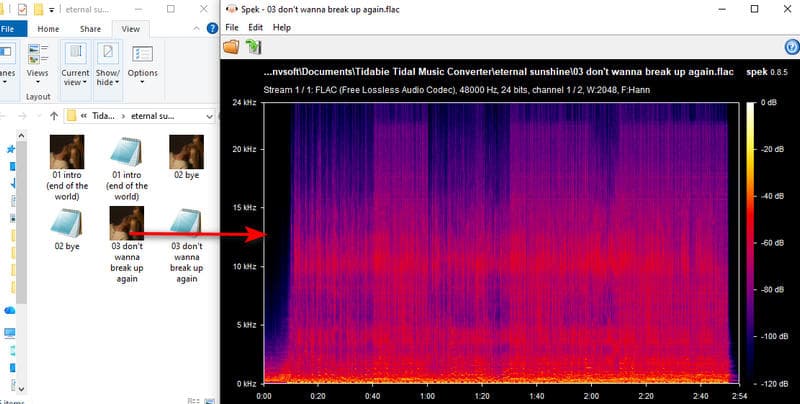
For anyone into good sound, the main question is simple: is this software actually giving us real high-res audio, or is it just a gimmick? To find out, I downloaded several tracks using Tidabie and dropped one of the FLAC file into a free tool called Spek to see what was really going on inside.
The results speak for themselves. The file showed up as a true 24-bit / 48000 Hz FLAC track, which is exactly what Tidal calls Hi-Res. But here is how you can tell it is the real deal without being an audio expert. With regular CDs or cheap MP3s, the sound cuts off flat at 22kHz. It looks like it was hit by a meat cleaver because those lower-quality formats just throw away the super high notes to save file space.
If you look at my screenshot, the colorful lines do not stop. They naturally push all the way up to the 24kHz ceiling. Those tiny purple and blue streaks at the very top are the hidden details, like the crispness of a cymbal or the actual breathing room of the studio recording. There are no blank spaces or fake lines here. It is just clean, uncompressed sound, meaning the software is giving you the exact same master quality you hear on the official app.
Feature 4: Say Goodbye to Messy Track Names and Missing Covers
If you have been fighting streaming restrictions for as long as I have, you have probably hunted around online and tried those sketchy free tools that promise the world. I know I have. But here is the thing: I am insanely picky about how my local music library looks. I absolutely lose my mind when a song turns out to be a upscaled, fake high-res file with a scrambled file name and zero sorting. That is an instant dealbreaker for me.
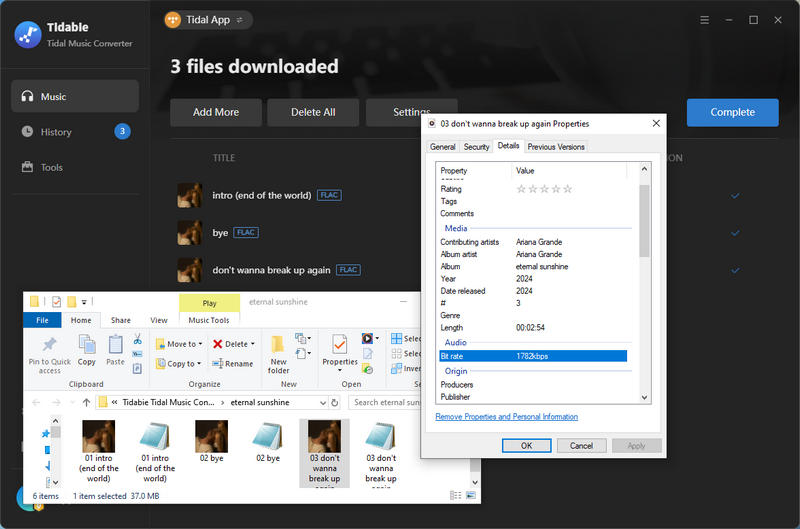
I heard through the grapevine that Tidabie had a massive edge here just by being a dedicated desktop app, so I decided to test it. Right out of the gate, it perfectly grabbed and locked in all the essential info like album art, artist details, and track numbers.
The customization in the settings menu is pretty decent. You get enough control over how your files are named and organized. I tested it with a few playlists and full albums, and the software kept every single track in its exact original order, dumping them into folders named perfectly after the original albums. It saved me a ton of manual cleanup time.
-
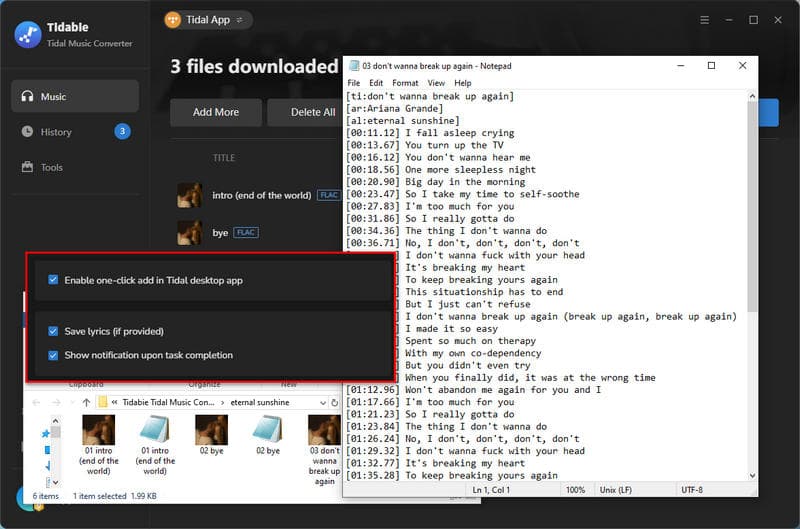
💡 Quick Tip: By the way, if you scroll all the way to the bottom of the settings menu and toggle on the option to save lyrics, you will find that Tidabie can actually download them in the standard LRC format. It is a nice little bonus feature if you like having scrolling lyrics on your local player.
Feature 5: Handy Extras (Beyond Downloading)
While the main goal of this software is downloading, I found a few extra tools tucked away that are actually pretty useful for day-to-day tasks.
- Qucik Playback: You don't necessarily have to jump out of the app to check what you just downloaded. If you go to the History module, you can double-click any song to play it right there. It's a simple way to do a quick quality check.
- Basic Utility Tools: In the Tools menu, there are a few extra utilities included. These let you convert audio formats, edit song tags, or burn CDs. They aren't going to replace a professional-grade audio workstation, but they save you the trouble of downloading separate apps just to fix a missing album cover or convert a file to MP3.
These extras don't change the game, but they are decent to have if you are already using the software and need a quick fix for your local files.
Part 3. How to Use Tidabie to Export Tidal in Lossless FLAC
You don't need a massive manual to get this right. Based on my testing, here is the exact, step-by-step setup to guarantee you are pulling the true master quality instead of accidentally downloading a downgraded file.
Step 1 Choose Your Music Source and Change Output Settings
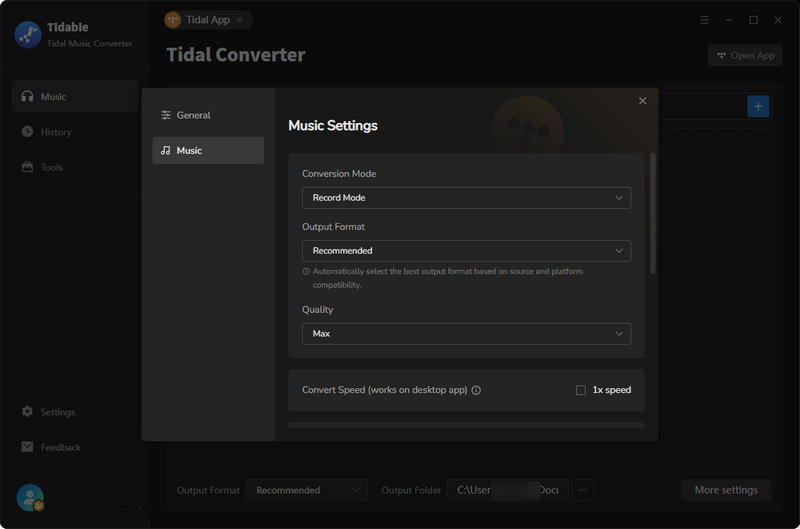
Launch Tidabie. You can choose to convert songs from the Tidal app or the web player, depending on your needs. Then, log in to your Tidal account on the Tidal app or the built-in web player. Next, click "Settings" in the bottom left corner. To ensure the best sound quality, I recommend the following settings:
- Conversion Mode: Record Mode
- Output Format: Recommended
- Quality: Max
Other options, such as Output File Name, Output Folder, and output organization, can be customized according to your actual needs.
Step 2 Parse and Convert the Tidal Tracks
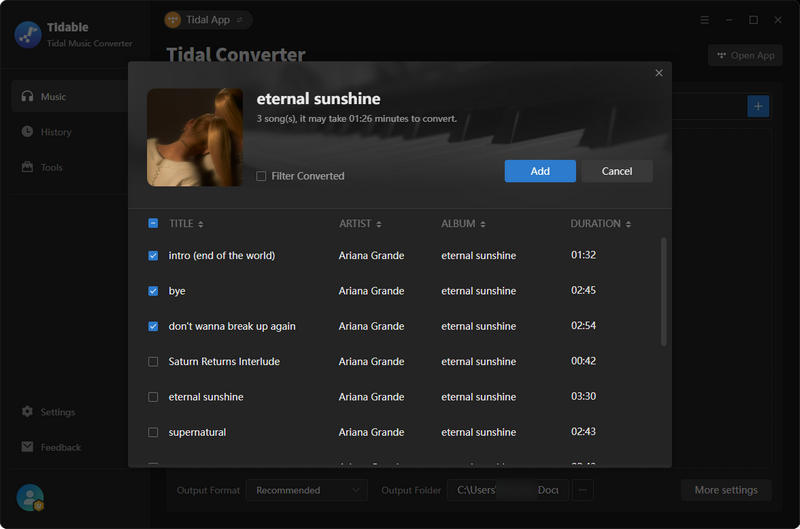
Open your target Tidal playlist, album, or artist. Click the "+" icon to parse. Then, select the tracks you want, and click "Add".
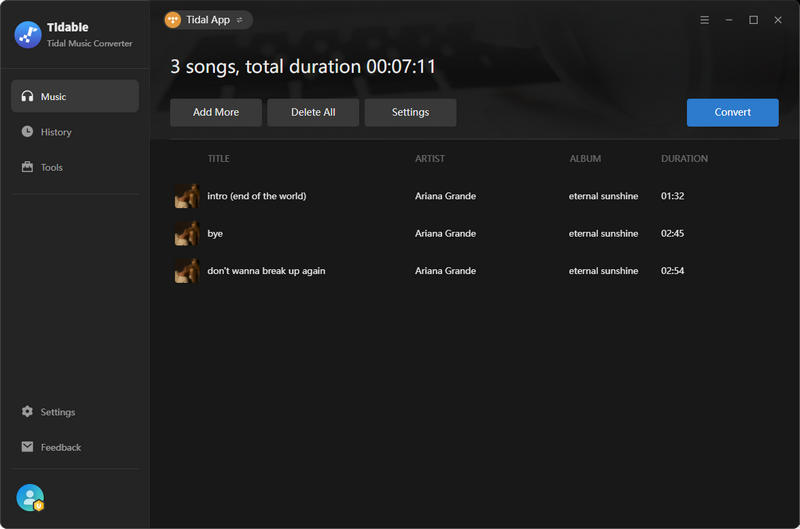
Finally, click "Convert" to start downloading the music to your computer.
Step 3 Check the Converted Tidal Songs
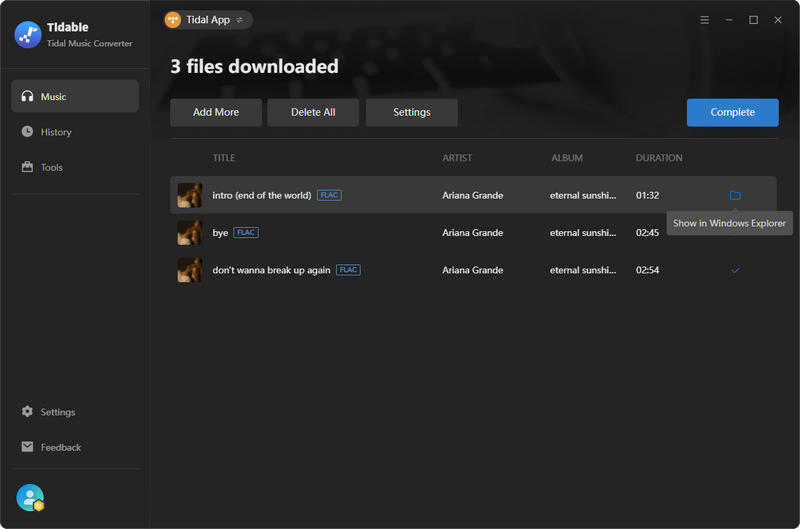
Once complete, click the "History" tab on the left sidebar to view your downloads, or simply open your preset output folder to find the saved Tidal audio files on your computer.
Part 4. Critiques & Truth: Fact-Checking the Rumors
Now let's talk about the dark side of Tidabie. I wanted to investigate those scary complaints on Reddit and Trustpilot, and here is what I discovered after my real world testing.
The "Fake FLAC" Rumor: Is the Audio Audirvana Approved?
If you search for opinions online, you might see Reddit users claiming this software sells "fake FLACs."
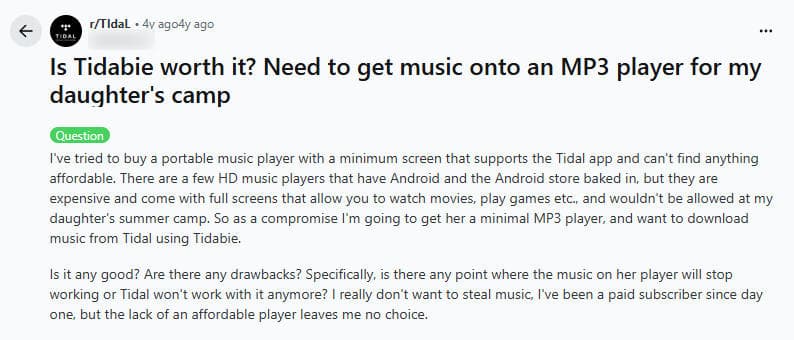
This user's complaint from four years ago is actually about Tidal’s old limitations. Back then, converting songs from the Tidal web player maxed out at CD quality. That was naturally lower than converting from the Tidal app. So, my guess is they were simply limited by the Tidal web player's lower quality source back then.
Setting that aside, a lot of the confusion comes down to how "Intelligent Mode" works. Based on my testing, this mode prioritizes download completion. If your internet connection stutters, the software may automatically switch to YouTube as a backup source to ensure the download doesn't fail. While this is helpful for users with unstable internet who just want the file, YouTube's audio quality is lower than Tidal's. Therefore, if you strictly want the original Tidal quality, it is better to manually choose Record Mode.
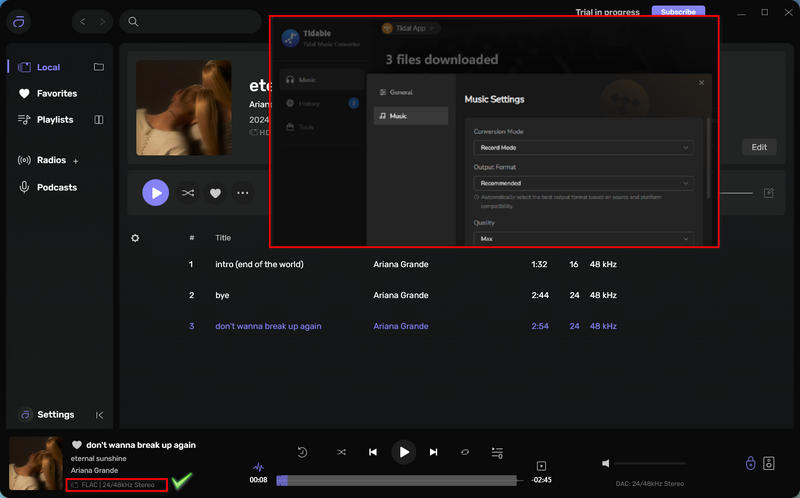
Here are my test results. I manually switched the mode to Record Mode, set the quality to Max, and chose Recommend for the output format. After downloading, I threw the files into Audirvana for a professional check. Audirvana looked right past the file extension and read the actual data. It proved the files are genuine 24-bit / 48 kHz Hi-Res audio. It even correctly spotted different bit depths across the same album, showing some tracks as 16-bit and others as 24-bit. This proves the software actually downloads the real master stream. It is not just slapping on a fake label.
The CPU Overheating Complaint: Will it Explode Your PC?
I noticed some angry complaints on Trustpilot claiming this software causes computer CPU temperatures to spike, so I decided to test it myself.
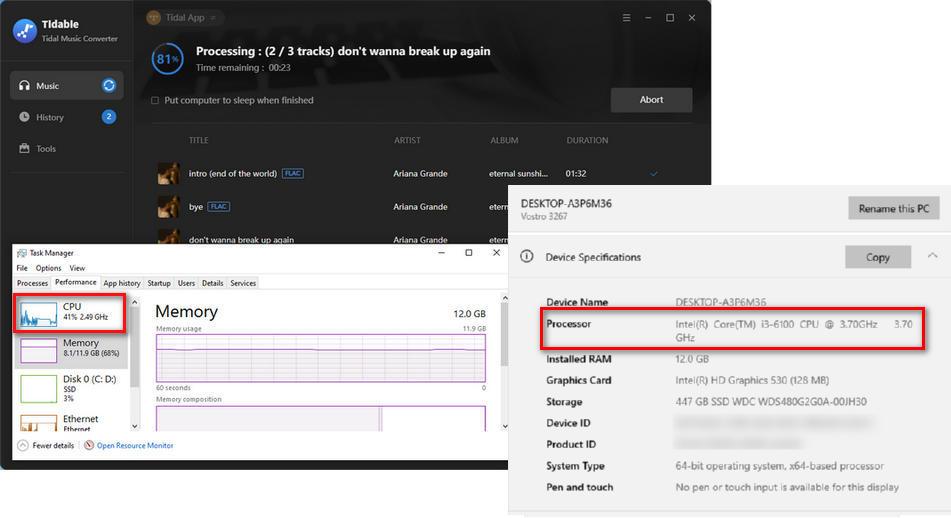
To give you some context, my test computer is far from a high-end gaming rig. In fact, it is a pretty dated budget setup running a 10-year-old Intel i3-6100 processor with 12GB of RAM and basic integrated graphics. If any system was going to choke and overheat on a heavy task, it would be this one. Before starting, I made sure to close all other unnecessary background programs.
My testing showed that a CPU usage of 40% to 70% is generally considered a normal workload for this type of software. During my test, the highest peak I saw was only 53%. Most of the time, the usage just bounced around safely between 8%, 17%, and 43%.
You can simply go into the settings menu and check the 1X speed option. This instantly cools down your CPU and helps mimic normal human listening behavior. The only downside is that you will need a little more patience to wait for the conversion to finish.
Customer Support: Why the "Ghosting" Reports?
If you check Trustpilot, you will see some users complaining about slow response times. The official promise is a reply within 48 hours. However, when I asked customer support about audio quality settings, I got a clear answer in about half a day. My overall experience was good. I also looked closer at other Trustpilot reviews and found many people praising them for quick and helpful support.
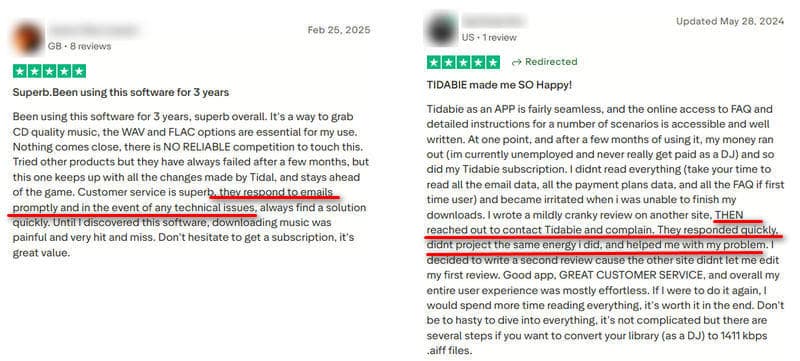
It seems like response times can vary a lot. I guess that this is just a time zone issue rather than a permanent problem. One thing is for sure: they do not ignore their users. I noticed they have a 100% reply rate on Trustpilot, even for bad reviews. They patiently explain issues and offer a 5-day or 30-day money-back guarantee. If you like the software because it performs well and gets the job done, I wouldn’t let a few complaints about slow support stop you from trying it.
Part 5. Final Verdict: Is Tidabie Worth Your Investment in 2026?
After putting Tidabie through its paces, it is clear that the software delivers exactly what it promises. However, you do need to know how to configure it correctly to get the most out of your purchase.
To give you a quick, transparent summary, here is an honest breakdown of the pros and cons based on my real-world testing.
What I Loved 👍
 True 24-bit Lossless Quality: You can get genuine Tidal Hi-Res FLAC files after conversion.
- 4–10X Conversion Speed: Supports batch music conversion for faster processing. Performance varies by device and network, but overall it delivers fast and stable conversion.
- Flawless Library Metadata: It automatically grabs and keep ID3 tags, album art, and lyrics.
- Smart Local Organization: You can customize output file names and sort tracks into folders exactly how you like, saving massive library cleanup time.
What to Consider 👎
 Tidal Web Source Risks: Pulling audio from the Tidal Web Player combined with Intelligent Mode can quietly downgrade your audio to MP3 if your internet jitters.
- No Instant Customer Support: There is no live chat or phone support, so you have to wait around 24 hours for email replies due to time zones.
Should You Buy It?
Let's be real. If you are just listening to music casually on cheap wireless earbuds, you probably won't notice the difference, and free online recording tools are more than enough for your daily needs. But if you are someone who owns a high-quality external DAC, a premium pair of headphones, or you just want to turn your subscription into a permanent local archive, streaming limitations can be incredibly frustrating.
For long term, true high-fidelity archiving, Tidabie is a reliable investment. The software itself is solid, you just need to be smarter than the default settings to get the master quality you are paying for.
If you are ready to build a flawless offline audio library, I highly recommend downloading their free trial, loading the files into Audirvana or your favorite player, and testing your favorite album today.
Olivia Anderson
Senior Writer